Every January, a wave of elaborate morning routines is launched, and most are gone by February. The usual diagnosis is a lack of discipline. The more accurate one is a lack of design. Habits are not held together by motivation, which fluctuates, but by structure, which does not. The research on how behaviours become automatic is surprisingly practical, and it points to a few simple choices that separate the routines that stick from the ones that quietly disappear.
Why most routines fail
The common failure mode is ambition. People design a morning built for their best self on their best day: meditation, journalling, exercise, cold plunge, an elaborate breakfast, all before work. It survives exactly as long as motivation runs high, which is usually a week or two. The first chaotic morning breaks the chain, and a broken chain feels like failure, so the whole structure is abandoned. The problem was never willpower. It was that the routine had no tolerance for an ordinary, imperfect day.
The mechanics of a habit
Behavioural research describes habits as a loop: a cue that triggers the behaviour, the routine itself, and a reward that tells the brain the loop was worth repeating. Over enough repetitions, the cue alone starts to summon the behaviour automatically, with little conscious effort. The practical lesson is that you do not build a habit by deciding harder. You build it by engineering a reliable cue, lowering the effort of the routine, and making sure there is a genuine reward.
Durable habits are built, not willed. Anchor the new behaviour to something you already do (a cue), make the first step almost effortlessly small, and give it a real reward. Aim for consistency over intensity, and forgive the occasional miss instead of abandoning the whole thing.
Anchor to an existing habit
The most reliable cue is a habit you already have. This is often called habit stacking: attach the new behaviour to an established one so the existing routine becomes the trigger. "After I fill the kettle, I make my Daylight." "After I sit at my desk, I write three lines." The old habit does the work of remembering, so you do not have to rely on a fragile new intention each morning.
Make the first step tiny
Shrink the entry point until it is almost too small to skip. Not a thirty-minute workout, but putting on your shoes. Not a full meditation, but one slow breath. The goal early on is not the outcome, it is the repetition, because automaticity comes from frequency, not from effort. Research on how long habits take to form found a wide range, commonly cited around two months on average, but with the consistent finding that what matters is repeating the behaviour in a stable context, not heroics on any single day. A tiny step you do daily beats an ambitious one you do twice.
Attach a real reward
A reward closes the loop and tells your brain to keep the habit. It does not have to be elaborate. The warmth of a good drink, a few minutes of quiet before the day demands anything, the small satisfaction of a streak unbroken. This is part of why a morning beverage makes such a sturdy anchor: it is pleasant, it is sensory, and it happens at a fixed point every day. The ritual rewards itself, which is exactly what a habit loop needs.
Consistency over intensity, and forgive the miss
The single most useful mindset shift is to value showing up over showing off. A modest routine done almost every day will reshape your mornings far more than a spectacular one done sporadically. And when you do miss, which you will, treat it as a single data point rather than a verdict. The research is clear that an occasional lapse does not meaningfully derail habit formation, as long as you return the next day. The people who keep their rituals are not the ones who never miss. They are the ones who never miss twice.
A ritual worth keeping
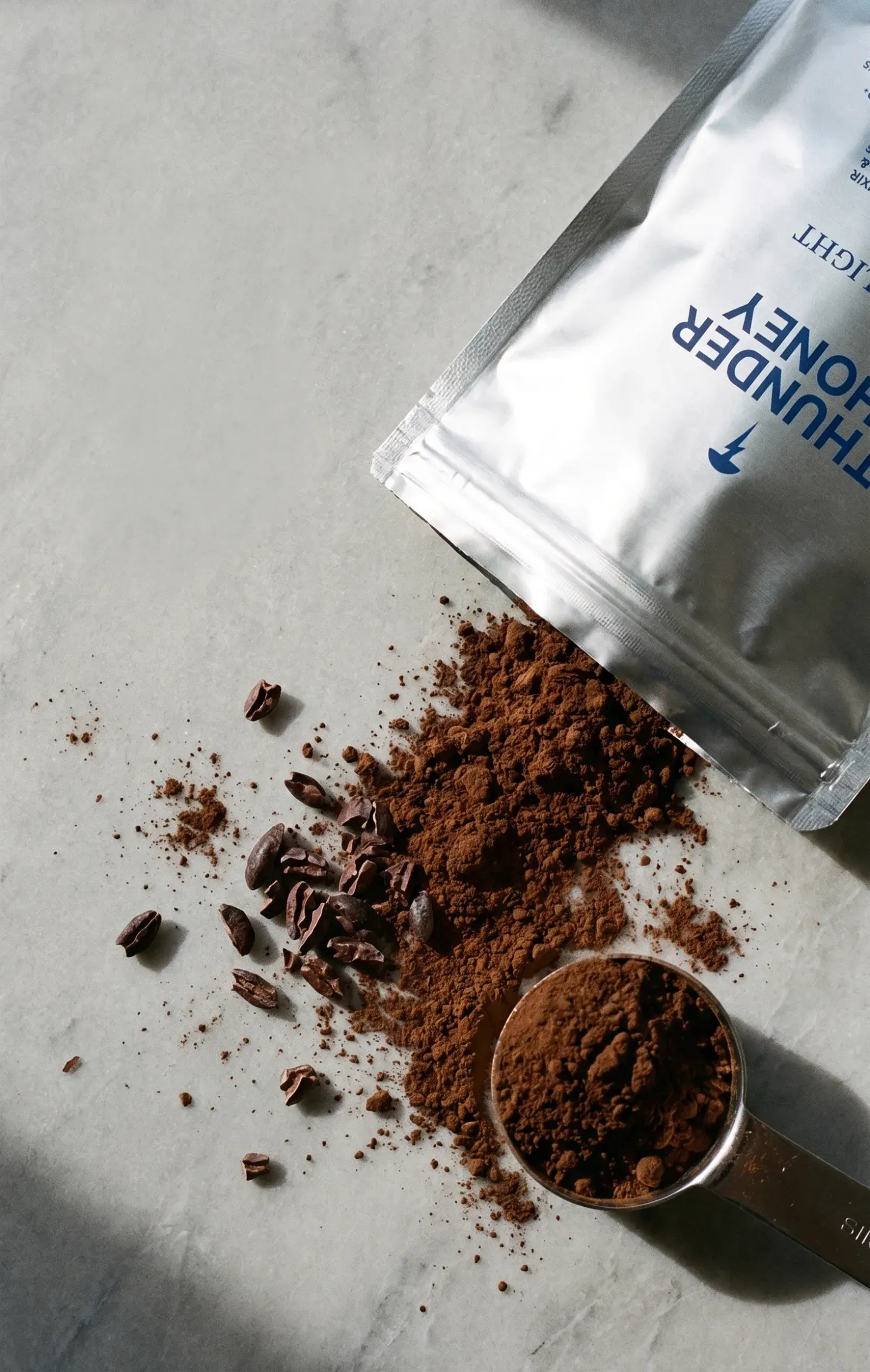
This is the thinking behind the way we frame Thunder Honey Daylight. It is designed to be the warm, sensory centre of a morning you actually look forward to: a no-added-caffeine cacao drink that tastes closer to a homemade hot chocolate than to coffee, with 11 actives supporting steady energy rather than a spike. The point is not to add another task to your morning. It is to give you one small, reliable, genuinely pleasant anchor that the rest of a good routine can stack onto.
You do not need more discipline. You need better design. Anchor the new behaviour to an existing one, start absurdly small, build in a real reward, and prize consistency over intensity. Miss a day without drama, and just do not miss twice. That is how a morning ritual quietly becomes permanent.
References
- Lally, P., et al. (2010). How are habits formed: modelling habit formation in the real world. European Journal of Social Psychology, 40(6), 998-1009.
- Wood, W., & Neal, D. T. (2007). A new look at habits and the habit-goal interface. Psychological Review, 114(4), 843-863.
- Gardner, B., Lally, P., & Wardle, J. (2012). Making health habitual: the psychology of habit-formation and general practice. British Journal of General Practice, 62(605), 664-666.
- Verplanken, B., & Wood, W. (2006). Interventions to break and create consumer habits. Journal of Public Policy & Marketing, 25(1), 90-103.
This article is for educational purposes and is not medical advice. Daylight is a food supplement. If you take prescription medication or are pregnant or breastfeeding, talk to your doctor before starting.