Almost everyone knows the feeling. The morning goes well, lunch is fine, and then somewhere around three in the afternoon the lights dim. Focus thins, your eyelids get heavy, and the work that felt easy at ten now feels like wading. The reflex is to blame yourself, or to reach for another coffee. Neither is quite right. The 3pm slump is largely physiology on a schedule, and three forces tend to arrive together.
Force one: your circadian rhythm
Your body runs on an internal clock, and that clock has a built-in dip. Alertness is governed in part by your circadian rhythm and by sleep pressure, the slow build-up of adenosine across the day. In the early afternoon there is a natural trough in the circadian alerting signal, often called the post-lunch dip. It happens even in people who skip lunch entirely, which tells you it is not just about the meal. This is a biological low point, scheduled into the day.
Force two: blood sugar
Lunch matters too, just not the way folklore says. A lunch heavy in fast carbohydrates spikes blood glucose, prompts a large insulin response, and can be followed by a dip that leaves you foggy and craving more of the same. The bigger and quicker the spike, the harder the comedown. This is why a sandwich-and-soda lunch tends to flatten people more than a meal balanced with protein, fat and fibre.
Force three: the fading coffee
If your energy depends on a morning coffee, the afternoon is also when that loan comes due. Caffeine does not create energy; it blocks adenosine, the molecule that signals fatigue. While it is working, adenosine keeps accumulating in the background. As the caffeine clears in the early afternoon, the backlog floods in at once. The slump you feel at three is partly the morning's borrowed alertness being repaid with interest.
The 3pm slump is your circadian dip, a post-lunch blood-sugar swing and a fading morning coffee all landing in the same window. You cannot delete the circadian dip, but you can soften it: balance lunch, get daylight and movement, and stop relying on caffeine that you have to repay each afternoon.
How to beat it
You cannot abolish the circadian dip, but you can keep it from becoming a wall.
- Balance lunch. Pair carbohydrates with protein, fat and fibre to flatten the glucose curve and avoid the rebound dip.
- Get outside. A short walk in daylight raises alertness and helps anchor your circadian rhythm. Even ten minutes counts.
- Move and hydrate. A few minutes of movement and a glass of water often do more than another coffee, with nothing to pay back later.
- Front-load demanding work. Schedule your hardest thinking for late morning, when the alerting signal is high, and save lighter tasks for the afternoon trough.
- Stop borrowing. If the afternoon crash tracks your morning caffeine, the real fix is to stop running on a loan that comes due at three.
Building a floor instead of a spike
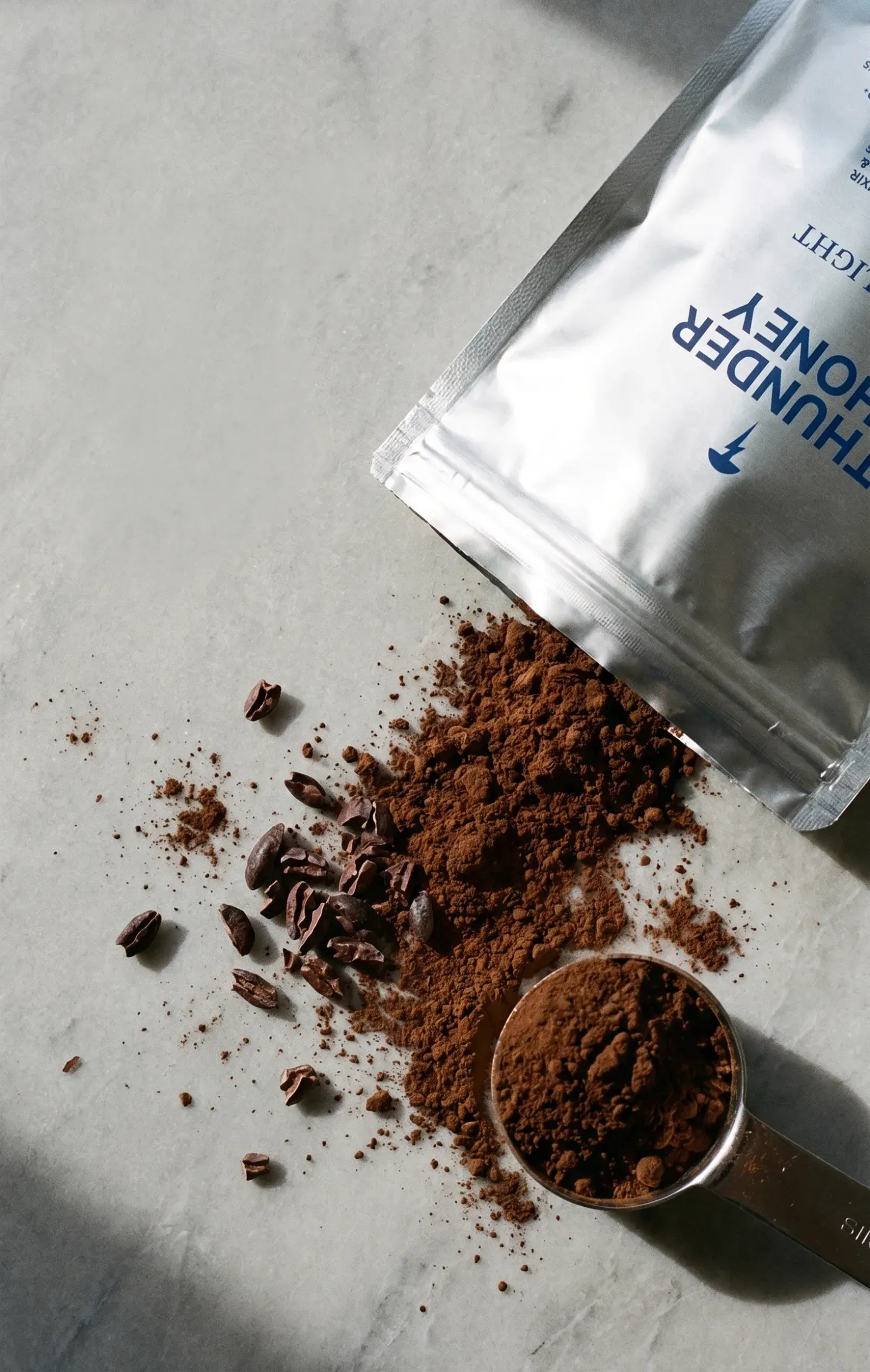
This is the thinking behind the composition of Thunder Honey Daylight. It is made without added caffeine, so it adds no adenosine masking and nothing to repay in the afternoon. Instead of a stimulant load, the formula is built around 11 actives on the label, including cordyceps, a nicotinamide riboside dose that supplies NAD+, and L-theanine. These actives carry no authorised EU health claim, so we describe the composition and the research rather than promising an effect: cordyceps has been studied for oxygen efficiency, nicotinamide riboside has been studied as an NAD+ precursor, and L-theanine has been studied for its effect on attention. The niacin (vitamin B3) carried by the nicotinamide riboside is the part with an authorised claim, contributing to normal energy-yielding metabolism and to the reduction of tiredness and fatigue. The taste sits closer to a homemade hot chocolate than to coffee, which makes it an easy ritual to keep.
The 3pm slump is real and mostly scheduled. Work with it: balance your lunch, get daylight and a short walk, and stop depending on caffeine you have to repay each afternoon. Build the day around those habits and the dip becomes a soft trough rather than a wall.
References
- Monk, T. H. (2005). The post-lunch dip in performance. Clinics in Sports Medicine, 24(2), e15-e23.
- Borbély, A. A., et al. (2016). The two-process model of sleep regulation: a reappraisal. Journal of Sleep Research, 25(2), 131-143.
- Lennerz, B. S., et al. (2013). Effects of dietary glycemic index on brain regions related to reward and craving. American Journal of Clinical Nutrition, 98(3), 641-647.
- Wright, K. P., et al. (2013). Entrainment of the human circadian clock to the natural light-dark cycle. Current Biology, 23(16), 1554-1558.
This article is for educational purposes and is not medical advice. Daylight is a food supplement. If you take prescription medication or are pregnant or breastfeeding, talk to your doctor before starting.