Few molecules have travelled from biochemistry textbooks to wellness headlines as fast as NAD+. It is framed as an anti-ageing switch, a cellular fountain of youth, a reason to take expensive infusions. Strip away the marketing and what remains is genuinely important, just quieter and more mechanical than the hype suggests. NAD+ is not magic. It is infrastructure.
What NAD+ actually does
NAD+, short for nicotinamide adenine dinucleotide, is a coenzyme present in every living cell. Its core job is to shuttle electrons during metabolism, the chemistry that converts the food you eat into ATP, the molecule your cells spend on everything they do. Without enough NAD+, the energy assembly line slows. Mitochondria, the power plants of the cell, depend on it directly.
NAD+ has a second role that drives most of the longevity interest. It is the required fuel for two families of repair and regulation enzymes: the sirtuins, which influence how genes are expressed and how cells respond to stress, and the PARPs, which help repair damaged DNA. Both of these spend NAD+ to do their work. When NAD+ is scarce, repair and regulation compete with energy production for the same dwindling supply.
Why levels fall with age
Here is the part that connects NAD+ to ageing. Across animal and human studies, tissue NAD+ levels decline measurably over the decades. The fall appears to come from both sides of the ledger: we make somewhat less, and we consume more, partly because accumulating DNA damage keeps the PARP enzymes busy and hungry. The net effect is a slow erosion of the molecule your cells rely on for both energy and maintenance, which is one plausible thread in why fatigue and slower recovery creep up with age.
NAD+ is the coenzyme cells use to turn food into energy and to power DNA repair. Levels fall with age. You cannot usefully swallow NAD+ itself, so the practical approach is a precursor like nicotinamide riboside, which reliably raises NAD+ in human blood. The longer-term anti-ageing claims are promising in animals and still being tested in people.
Why you cannot just take NAD+ directly
The obvious idea, swallow NAD+ to top up your NAD+, does not work well. The intact molecule is large and unstable in the gut, and is largely broken down before it reaches cells. The route that does work is to supply a building block the body readily converts. The most studied oral precursors are nicotinamide riboside (NR) and nicotinamide mononucleotide (NMN). Both feed into the same salvage pathway your cells use to recycle NAD+.
NR has the better-developed human evidence base for actually raising NAD+. Multiple randomised, placebo-controlled trials have shown that oral nicotinamide riboside increases NAD+ in human blood in a dose-dependent way, and that it is well tolerated. That is a meaningful, measurable result: the precursor does what it claims to do biochemically.
What the evidence supports, and what it does not
This is where honesty matters. The strongest claims hold:
- NR reliably raises NAD+ in humans. This is well replicated.
- It is safe and well tolerated at studied doses across trials.
- In animal models, restoring NAD+ improves mitochondrial function, metabolic markers and some measures of healthspan.
The weaker claims are the exciting ones. Whether raising NAD+ extends human lifespan, reverses ageing or produces dramatic clinical benefits is not established. Human outcome trials are ongoing and the results so far are mixed and modest. The correct posture is interest without overpromising: a strong mechanism, a precursor that demonstrably works at the biochemical level, and outcome data that is still being written.
How we use it in Daylight
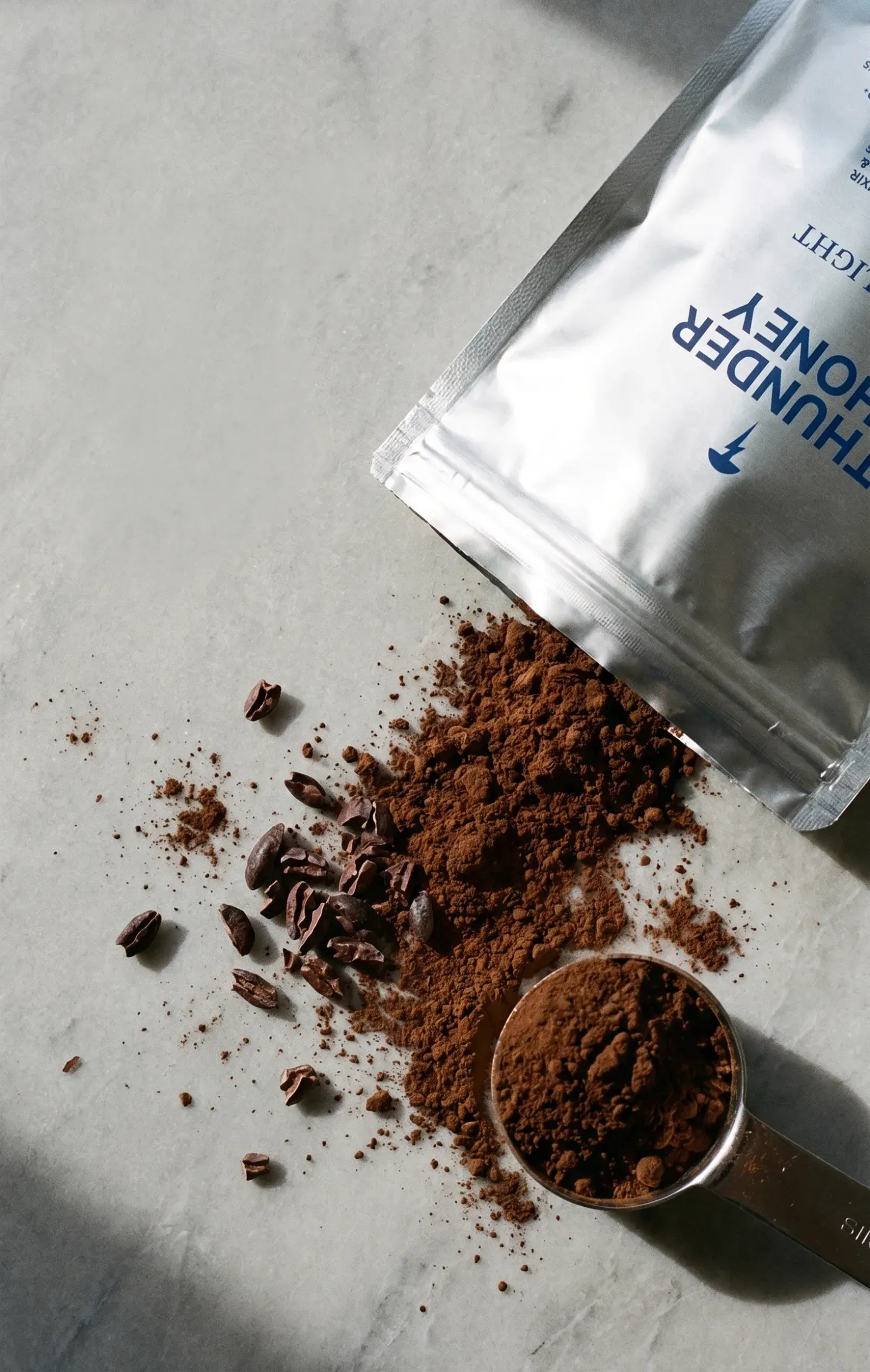
Thunder Honey Daylight includes 300 mg of nicotinamide riboside chloride per scoop, the NAD+ precursor with the most human data behind it, paired with cordyceps. These actives carry no authorised EU health claim, so we describe the composition and the research rather than promising an effect: nicotinamide riboside is the precursor researchers have studied for raising NAD+, and cordyceps has been studied for oxygen efficiency. The part of the formula with an authorised claim is the niacin (vitamin B3) the nicotinamide riboside supplies, which contributes to normal energy-yielding metabolism and to the reduction of tiredness and fatigue. It is no-added-caffeine by design. As with everything in the formula, every milligram on the label is in the scoop, with no proprietary blends hiding the dose.
NAD+ is real and important, and it falls with age. Nicotinamide riboside is the best-evidenced way to raise it in people, and it is safe. The lifespan-extension headlines run ahead of the human data. Treat NAD+ as a well-studied area of research, not as a guarantee of more years, and read the cellular-maintenance story as what scientists are still exploring rather than a promise.
References
- Trammell, S. A. J., et al. (2016). Nicotinamide riboside is uniquely and orally bioavailable in mice and humans. Nature Communications, 7, 12948.
- Martens, C. R., et al. (2018). Chronic nicotinamide riboside supplementation is well-tolerated and elevates NAD+ in healthy middle-aged and older adults. Nature Communications, 9, 1286.
- Covarrubias, A. J., et al. (2021). NAD+ metabolism and its roles in cellular processes during ageing. Nature Reviews Molecular Cell Biology, 22(2), 119-141.
- Rajman, L., Chwalek, K., & Sinclair, D. A. (2018). Therapeutic potential of NAD-boosting molecules: the in vivo evidence. Cell Metabolism, 27(3), 529-547.
This article is for educational purposes and is not medical advice. Daylight is a food supplement. If you take prescription medication or are pregnant or breastfeeding, talk to your doctor before starting.