Everyone has felt it. The work disappears into itself, time bends, the inner critic goes quiet and you simply do the thing well. Psychologists call this flow, and for decades it was treated as a happy accident. It is not. Flow has a set of identifiable conditions, and while you cannot force it on command, you can dramatically improve your odds by setting the stage. Focus is less a trait than an environment.
What flow actually is
Flow was named by the psychologist Mihaly Csikszentmihalyi, who studied people deeply absorbed in their work, artists, athletes, surgeons, and found a consistent pattern. In flow, attention narrows completely onto the task, self-consciousness fades, and the activity becomes intrinsically rewarding. It is the optimal state for both performance and enjoyment. Crucially, it appears under describable conditions rather than at random.
The conditions that produce it
A few factors come up again and again. A clear goal, so attention has somewhere to go. Immediate feedback, so you can adjust as you work. And above all, the right level of challenge: a task hard enough to demand your full attention but not so hard it tips into anxiety. Too easy and you drift into boredom. Too hard and you fall into stress. Flow lives in the narrow band where skill and challenge meet.
Flow appears under conditions: a clear goal, immediate feedback, and a challenge matched to your skill. The biggest modern obstacle is interruption, which shatters the deep attention flow requires. Protect uninterrupted blocks, remove distractions, and create an entry ritual, and flow becomes far more reliable.
The biggest obstacle: interruption
If flow has one great enemy in modern work, it is fragmentation. Deep attention takes time to build, often fifteen to twenty minutes of uninterrupted effort, and a single notification can collapse it in a second. Worse, research on task-switching shows the cost is not just the interruption itself but the slow climb back to depth afterward. A day chopped into five-minute pieces by alerts is a day in which flow can almost never occur, no matter how motivated you are.
How to set the stage
Practical levers, in order of impact: protect uninterrupted blocks of at least an hour for your most demanding work. Remove distractions physically, phone out of the room, notifications off, not merely intended to be ignored. Match the task to your energy, scheduling deep work when your alertness is naturally high, usually late morning. And build an entry ritual, a consistent small sequence that signals to your brain that focus time is beginning.
Where a focus ritual fits
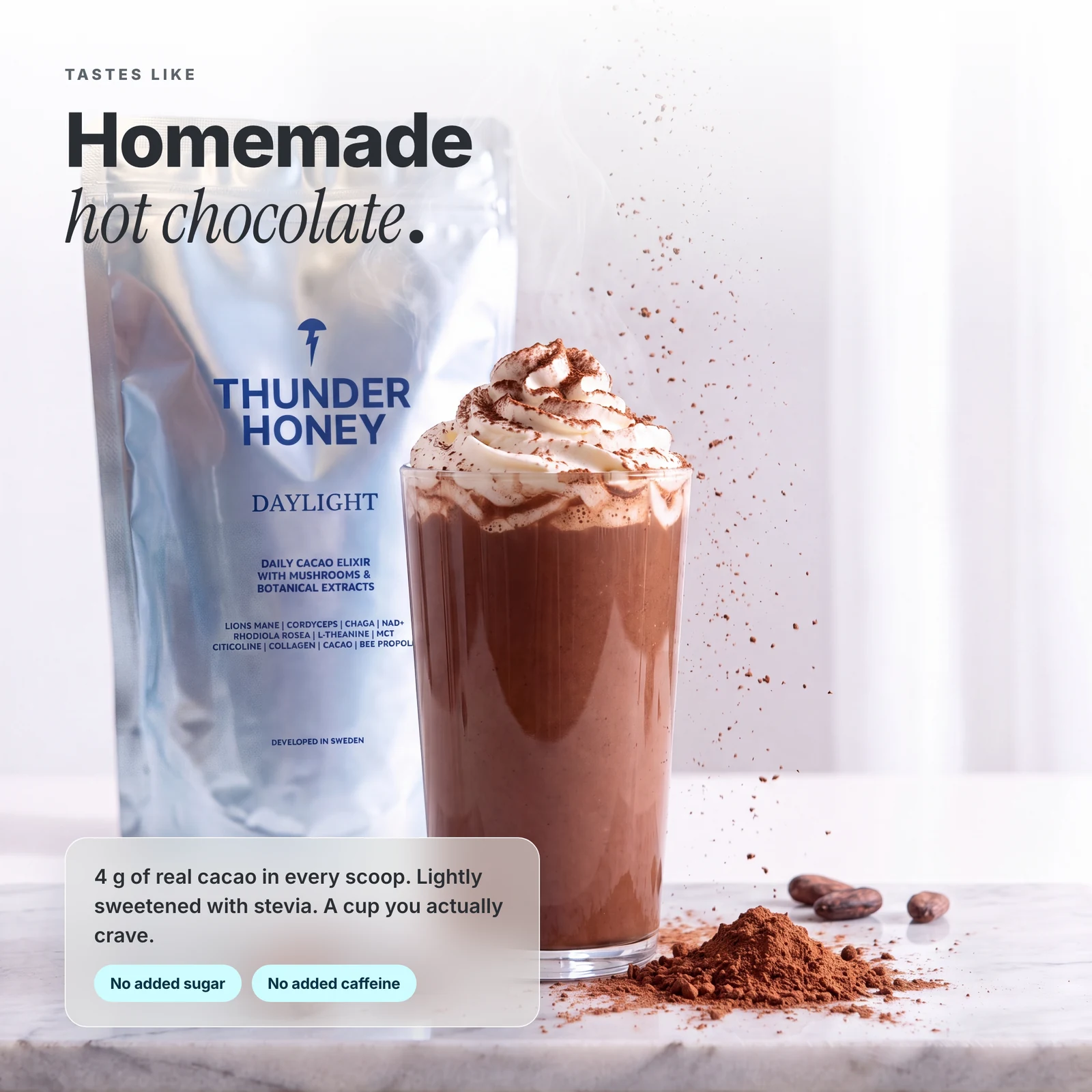
That last point is where a daily drink earns its keep. A warm, deliberate cup before deep work is a clean entry cue: it marks the boundary between scattered time and focused time. Thunder Honey Daylight gives that ritual a fixed shape, and it is made without added caffeine, so there is no caffeine spike to start the session on. The cup itself contains L-theanine, CDP-Choline and Lion's Mane among its 11 actives, each printed on the label. These actives carry no authorised EU health claim, so we describe what is in the cup and what the research has explored rather than promising an effect on your focus.
Flow is engineered, not wished for. Set a clear goal, match challenge to skill, and above all protect uninterrupted time from the interruptions that shatter deep attention. Add an entry ritual to mark the boundary. Calm, steady focus is the soil flow grows in, so cultivate that first.
References
- Csikszentmihalyi, M. (1990). Flow: The Psychology of Optimal Experience. Harper & Row.
- Mark, G., Gudith, D., & Klocke, U. (2008). The cost of interrupted work: more speed and stress. Proceedings of CHI 2008, 107-110.
- Nobre, A. C., Rao, A., & Owen, G. N. (2008). L-theanine and its effect on mental state. Asia Pacific Journal of Clinical Nutrition, 17(S1), 167-168.
This article is for educational purposes and is not medical advice. Daylight is a food supplement. If you take prescription medication or are pregnant or breastfeeding, talk to your doctor before starting.