Nootropic, a substance meant to support cognition, is one of the most exciting and most abused categories in supplements. A handful of ingredients have genuine human evidence. Many more ride on a plausible-sounding mechanism and almost no data. And the marketing rarely separates the two, because the bold claim sells better than the honest one. Here is a clear-eyed map, plus a simple way to evaluate anything that is not on it.
What actually has evidence
A few categories earn their place. Choline donors like CDP-Choline supply raw material for acetylcholine, the attention neurotransmitter, with real if modest human data for focus. L-theanine has solid evidence for calm, alert focus and stress reduction. Lion's Mane has human data for memory and cognition over weeks, strongest in older adults. Certain adaptogens, notably rhodiola, have reasonable support for reducing mental fatigue under stress. None of these are dramatic. All of them are real, measured and dose-dependent.
What is mostly hype
The category is full of ingredients whose evidence is thin, preliminary or confined to cell and animal studies, dressed up as proven. Many trendy mushroom and herb blends fall here, not because they are useless, but because the human data simply is not there yet and the claims pretend otherwise. The reddest flag is any product promising a dramatic, fast, switch-like cognitive boost. Real cognitive support is incremental and builds over time. Anything promising a limitless-style effect is selling a fantasy.
The nootropics with real human evidence are modest and specific: choline donors like CDP-Choline, L-theanine, Lion's Mane, and a few adaptogens. Most flashy claims rest on cell studies or nothing. Judge any nootropic by human evidence, stated dose, and an honest, incremental claim, and skip anything promising a dramatic switch.
What to skip
Three things reliably signal a product not worth your money. Proprietary blends that hide individual doses, so you cannot know if the good ingredients are present in meaningful amounts. Token doses, real ingredients sprinkled in below their effective range to justify a label claim. And miracle framing, the promise of instant, dramatic results, which is the surest sign someone is selling marketing rather than biology.
How to evaluate any claim
Four questions handle almost everything. Is there human evidence, not just cell or animal studies? Is the dose stated and in the range the studies used? Is the claim incremental and honest, or is it promising a dramatic switch? And is the formula transparent, with every ingredient and amount on the label rather than buried in a blend? A product that passes all four is worth considering. One that fails any of them belongs back on the shelf.
The case for a transparent stack
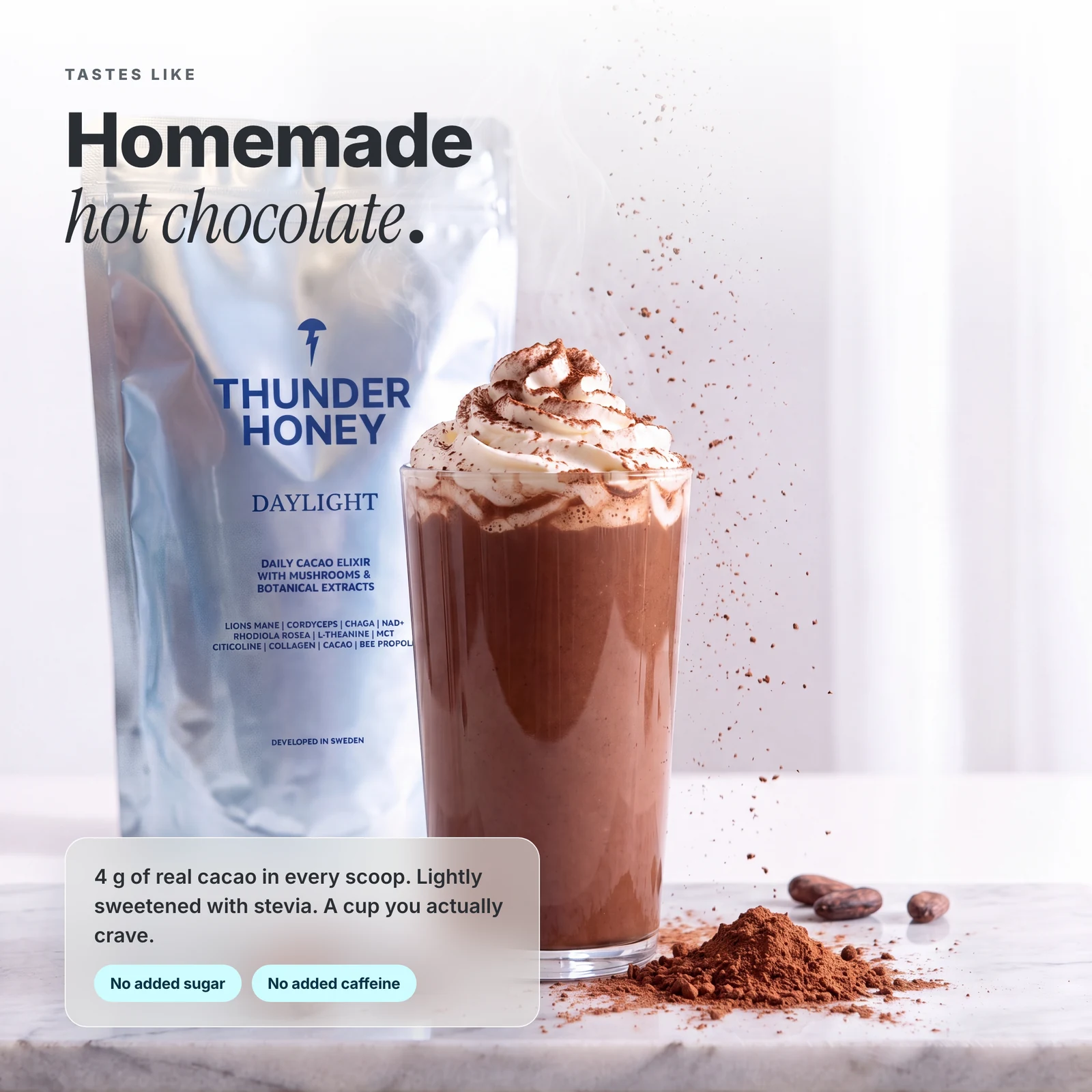
This is the standard Thunder Honey Daylight is built to meet. Its cognitive actives are the ones with real support, CDP-Choline, L-theanine and dual-extracted Lion's Mane, each at a stated, meaningful dose, with no proprietary blends and no miracle framing. The claim is exactly as modest as the evidence: calm, sustained focus support that builds with consistent use, inside a broader 11-active formula. That is what an honest nootropic looks like.
Real nootropics are modest, specific and dose-dependent: choline donors, L-theanine, Lion's Mane, a few adaptogens. Most of the market is hype on thin data, token doses or hidden blends. Ask four questions, human evidence, stated dose, honest claim, transparent label, and you can sort the genuine from the decorative in under a minute.
References
- Suliman, N. A., et al. (2016). Establishing natural nootropics: recent molecular enhancement. Evidence-Based Complementary and Alternative Medicine, 2016, 4391375.
- McGlade, E., et al. (2012). Improved attentional performance following CDP-Choline administration. Food and Nutrition Sciences, 3(6), 769-773.
- Hidese, S., et al. (2019). Effects of L-theanine on stress-related symptoms and cognitive functions. Nutrients, 11(10), 2362.
This article is for educational purposes and is not medical advice. Daylight is a food supplement. If you take prescription medication or are pregnant or breastfeeding, talk to your doctor before starting.